

PRACTICAL GUIDE | EMPLOYMENT AND SOCIAL SECURITY
Cochabamba, October 2026
If the minimum wage goes up, so does the seniority bonus of every worker with two or more years in the company, whatever they earn. Build your 2027 budget with that effect included.
I. Background
On 13 January 2026, through Supreme Decree No. 5516, the Government set the National Minimum Wage at Bs 3,300, 20% above the Bs 2,750 of 2025, retroactive to 1 January 2026. The rest of the salary was left to negotiation between employers and workers, provided that agreements are made in writing.
The economic context is pushing towards a new adjustment. In its Inflation and Monetary Policy Report for the second quarter of 2026, the Central Bank of Bolivia projected 9.22% inflation for the year and a GDP contraction of around 3.6%; in October it confirmed that inflation projection. Add to this the new diesel pricing regime and an official exchange rate that is no longer fixed.
II. What we know about the 2027 increase
There is no percentage or official decision yet, but the issue is already on the table:
• Government: on 6 October, the Vice Minister of Treasury and Public Credit, Óscar Navarro, said he believes there will be an increase in 2027, aimed at restoring lost purchasing power, with the percentage to be negotiated when the year begins. The next day, the Minister of Labour, William Bascopé, explained that seven indicators will be analysed: purchasing power, the value of the boliviano, inflation, the dollar exchange rate, imports, exports and employment. On 19 October he clarified that the Government has not yet announced any increase and that it will be addressed in due course.
• Workers: the COB (Bolivian Workers' Central) has said it will ask for a National Minimum Wage of Bs 7,000 and a 10% increase in base salaries.
• Retroactivity: as in 2026, the increase will likely apply from 1 January even if the decree comes later. It is advisable to provision for it from the first month.
III. The chain effect: the seniority bonus
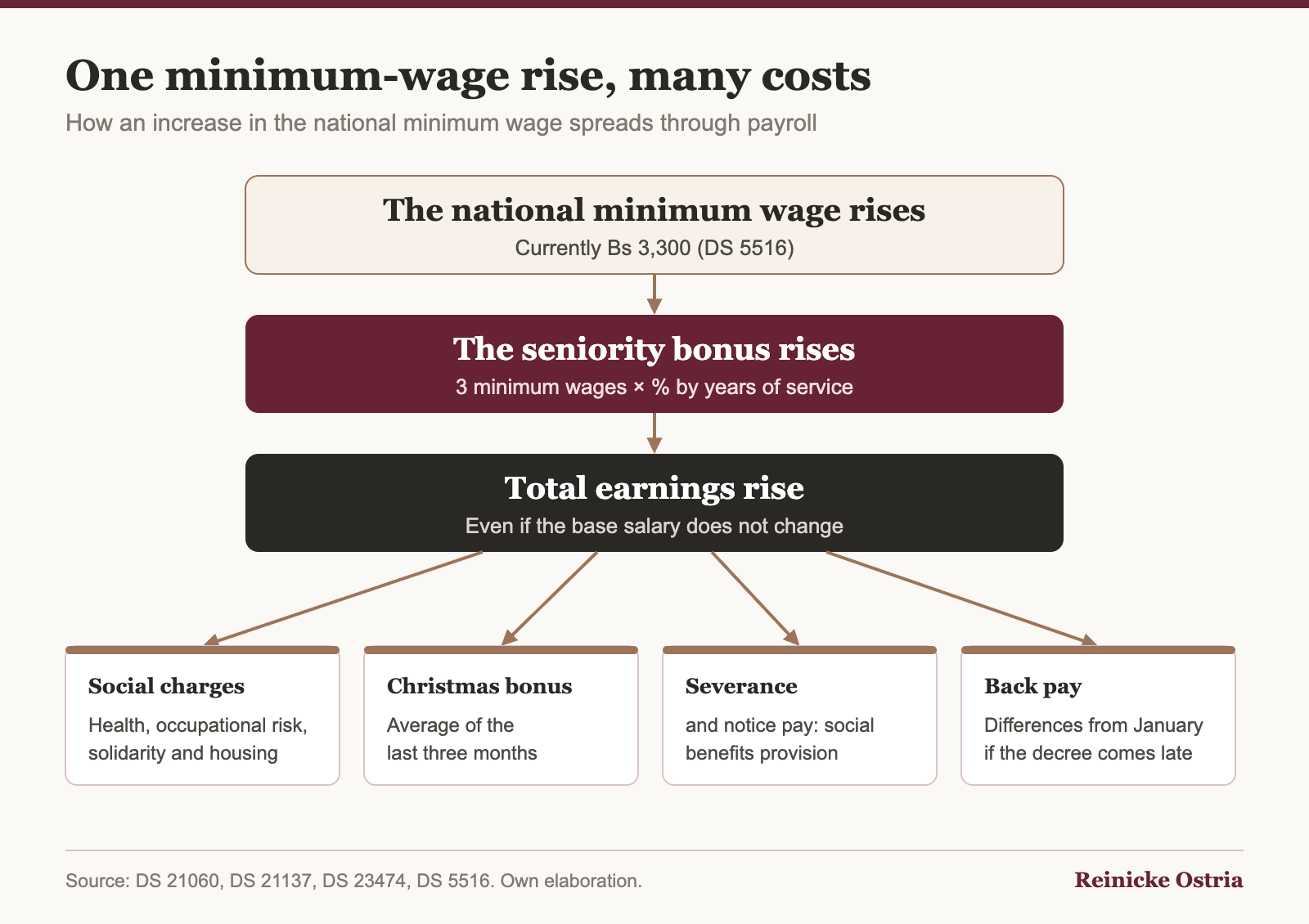
Many employers believe that if nobody on their payroll earns the minimum wage, a minimum-wage increase does not affect them. That is not the case. The seniority bonus is not calculated on each worker's salary but on the minimum wage: in productive companies, on three national minimum wages (Supreme Decree No. 23474), a criterion that case law has in several cases extended to service companies. The scale ranges from 5% (2 to 4 years) to 50% (25 years or more), under article 60 of Supreme Decree No. 21060.
That is why, when the minimum wage rises, the bonus of all workers with seniority rises too, including managers and professionals whose salary does not change.
The table shows the monthly bonus at the current minimum wage and under an illustrative 10% increase. The actual percentage will be known once the 2027 decree is approved.
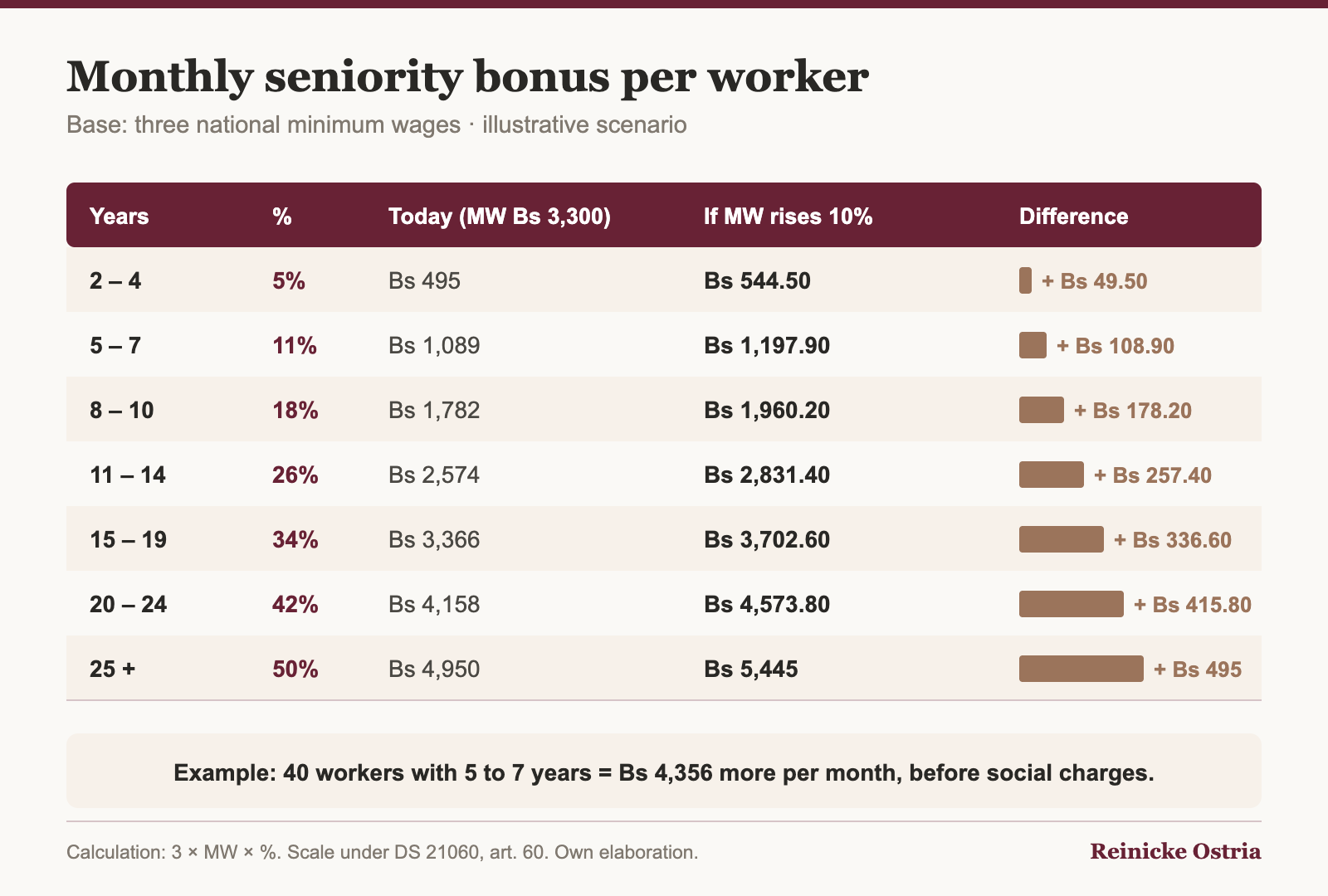
For example, a company with 40 workers with 5 to 7 years of service would pay around Bs 4,356 more per month in seniority bonus alone if the minimum wage rises 10%, before social charges and without raising any salary.
IV. Other costs that move with the increase
The payroll increase does not stop at salary and bonus. Each additional boliviano carries other costs:
• Employer contributions: health, occupational risk, employer solidarity contribution and housing are calculated on total earnings, so they rise in the same proportion.
• Christmas bonus (aguinaldo): calculated on the average earnings of the last three months, seniority bonus included. An increase retroactive to January is also reflected in the December 2027 aguinaldo.
• Severance and notice pay: calculated on the average of the last three months, so the social benefits provision must also be adjusted.
• Contracts and agreements: collective agreements, internal policies or contracts that tie benefits to the minimum wage (production bonuses, allowances, fixed overtime) may adjust automatically.
• Back pay: if the decree is issued months after January, as has happened in other years, differences from January must be paid at once, with an impact on cash flow.
V. Recommendations
1. Model scenarios now. Combine minimum-wage increases of 5%, 10% and 15% with base-salary increases of 0%, 5% and 10%. Calculate the total cost with social charges, not just salaries.
2. Separate the two effects. The minimum wage has an impact through the seniority bonus and the lowest salaries; the base-salary increase affects the whole payroll. They are different decisions in the negotiation.
3. Sort your payroll by seniority. The more workers you have in the upper brackets of the scale, the greater the impact of each point of minimum-wage increase.
4. Review contracts, collective agreements and internal policies that refer to the minimum wage or official increases.
5. Document in writing any voluntary increase granted before 2027, with amount and date, and state whether it is an advance on the mandatory increase.
6. Provision for back pay from January 2027 to avoid a cash-flow shock when the decree is issued.
7. Follow the wage negotiation, which is expected to open in early 2027.
VI. How we can help
At Reinicke Ostria we help you quantify the impact of the increase on your payroll, review your contracts and collective agreements and properly document voluntary increases. For more information, please contact us through our contact page.
Legal references
• Supreme Decree No. 5516 of 13 January 2026: National Minimum Wage of Bs 3,300.
• Supreme Decree No. 21060, article 60: seniority bonus scale.
• Supreme Decree No. 21137, article 13: basis for calculating the seniority bonus.
• Supreme Decree No. 23474: base of three minimum wages in productive companies.
This document is for information only and does not constitute legal advice. Each case must be assessed individually.
Reinicke Ostria — Vision beyond. Precision always.