

TAX | PRACTICAL GUIDE
Cochabamba, November 2026
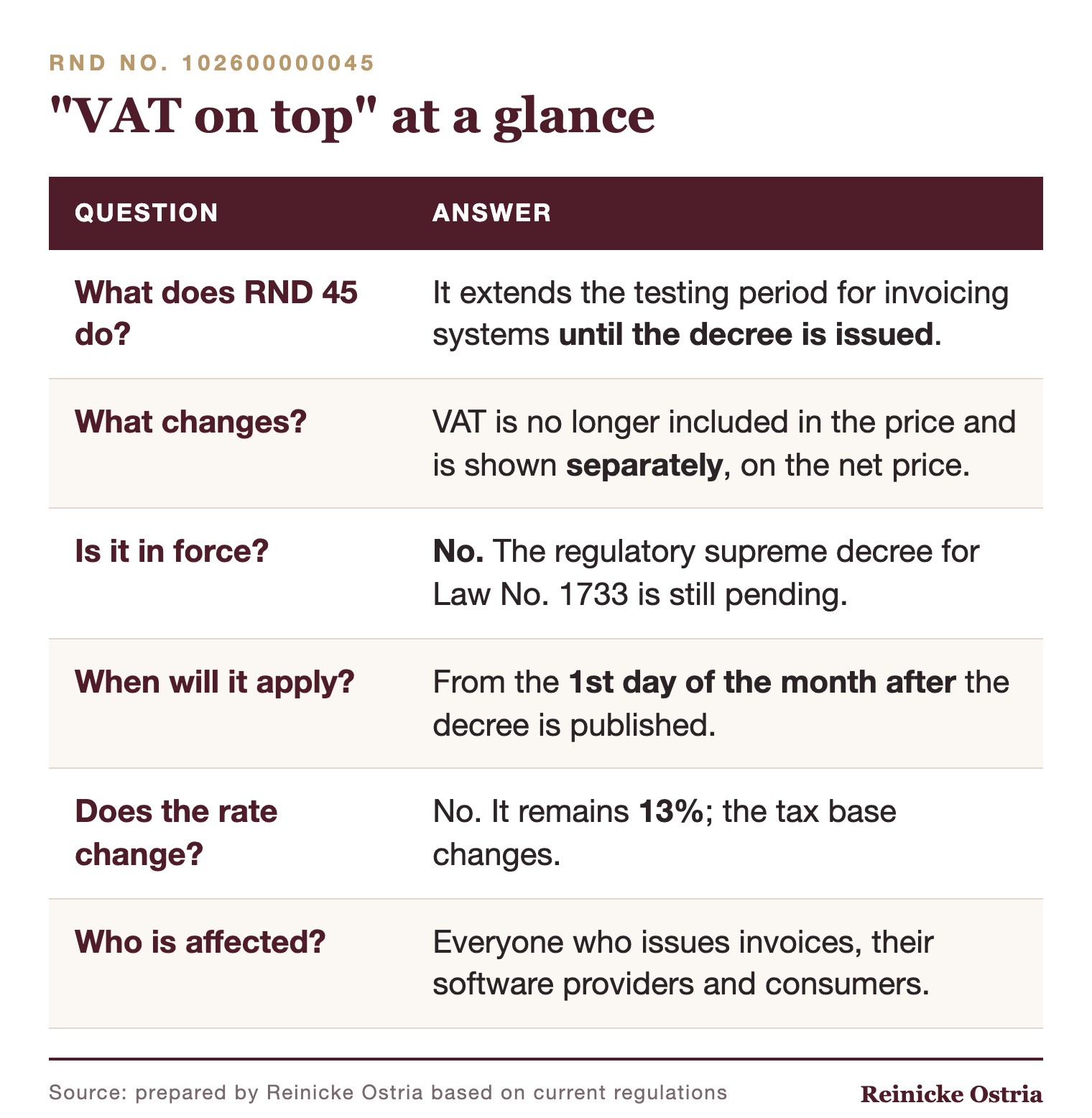
On November 13, 2026, the National Tax Service (SIN) issued Board Regulatory Resolution (RND) No. 102600000045, which extends the testing period for invoicing systems until the supreme decree regulating "VAT on top" (IVA por fuera), provided for in Law No. 1733, is published.
In simple terms: once that decree is issued, the way VAT is calculated and shown on every invoice in the country will change. Because the change takes effect on the first day of the month after its publication, companies could have very little time to adapt.
1. "VAT on top" at a glance
2. What does RND No. 102600000045 say?
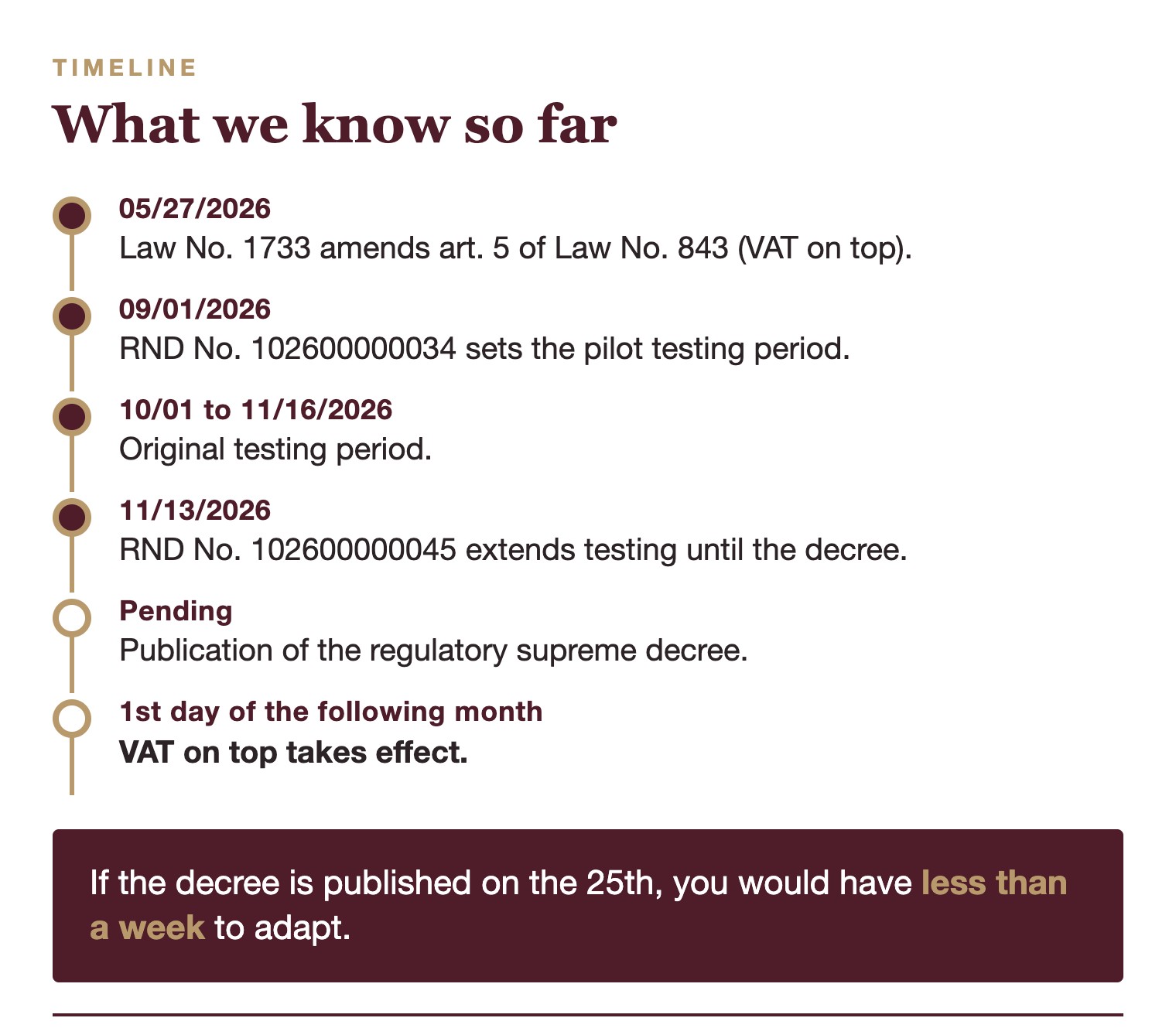
It has a single article. It amends article 2 of RND No. 102600000034 of September 1, 2026, which set a pilot testing period for invoicing systems from October 1 to November 16, 2026.
From now on, that period no longer has a fixed end date: it runs until the supreme decree regulating the Second Additional Provision of Law No. 1733 is published. In other words, the tax authority is keeping the testing environment open because systems will have to adapt to the new VAT calculation as soon as the decree is issued.
3. What did Law No. 1733 change?
Tax Relief Law No. 1733 of May 27, 2026 is known for debt forgiveness and settlement, but it also amended article 5 of Law No. 843. Under the new text:
• The VAT tax base is the net sale price, that is, the value of the good or service before taxes.
• VAT is not part of the net price and must be shown separately.
Today VAT is "included": the price the customer pays already contains the tax. With the change, VAT is added "on top", with the net price and the tax shown separately.
4. Practical example: how the calculation changes
Take a product with a net price of Bs 1,000 and the 13% rate. With VAT included, the 13% is calculated on the total price, which equals about 14.94% of the net price. With VAT on top, the 13% applies directly to the net price.
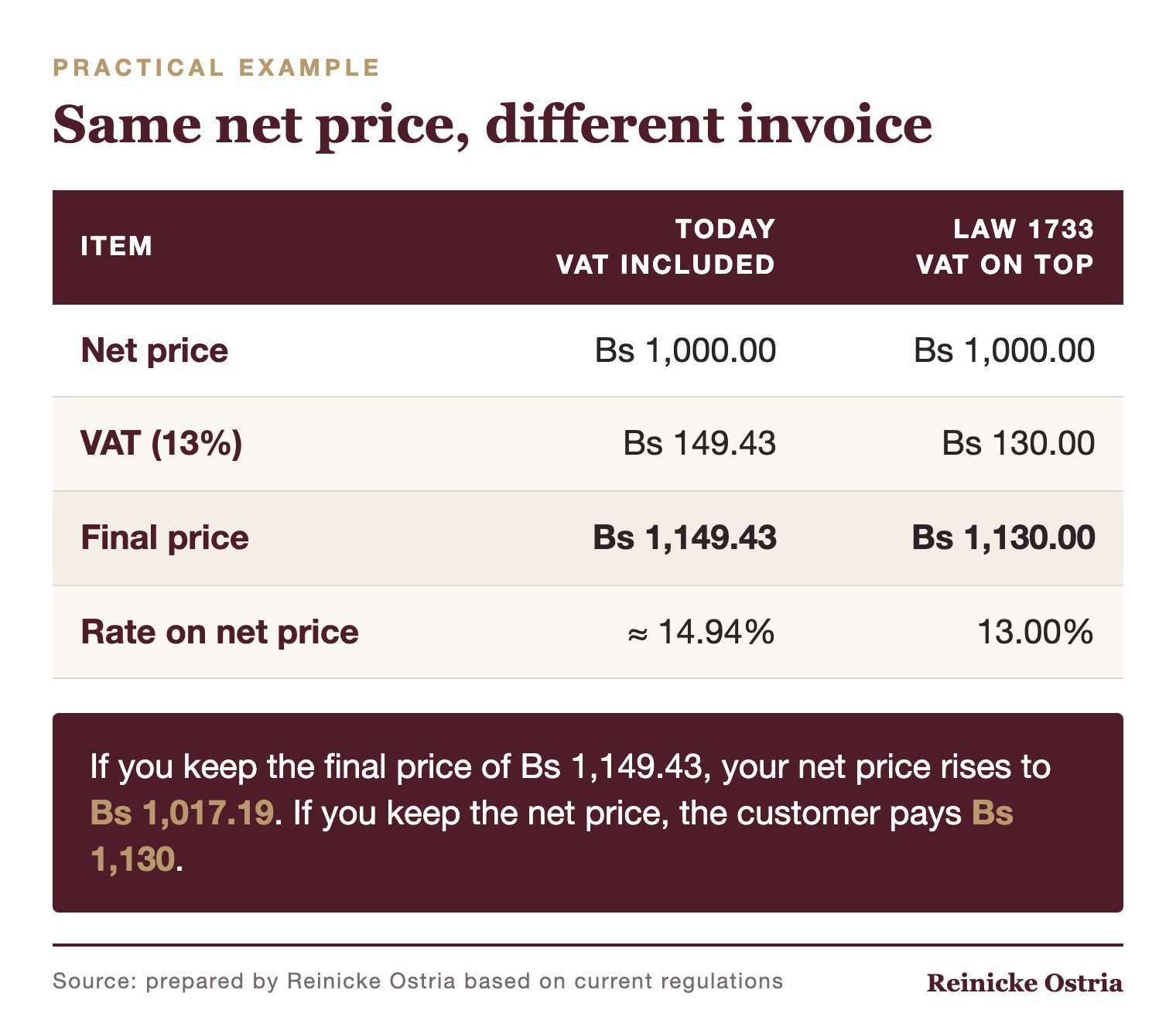
Whether to keep the final price or the net price is a business decision best made before the change takes effect.
5. When does it apply?
The law itself provides that the new treatment takes effect on the first day of the month following the publication of its regulatory supreme decree. As of November 16, 2026, that decree has not yet been published.
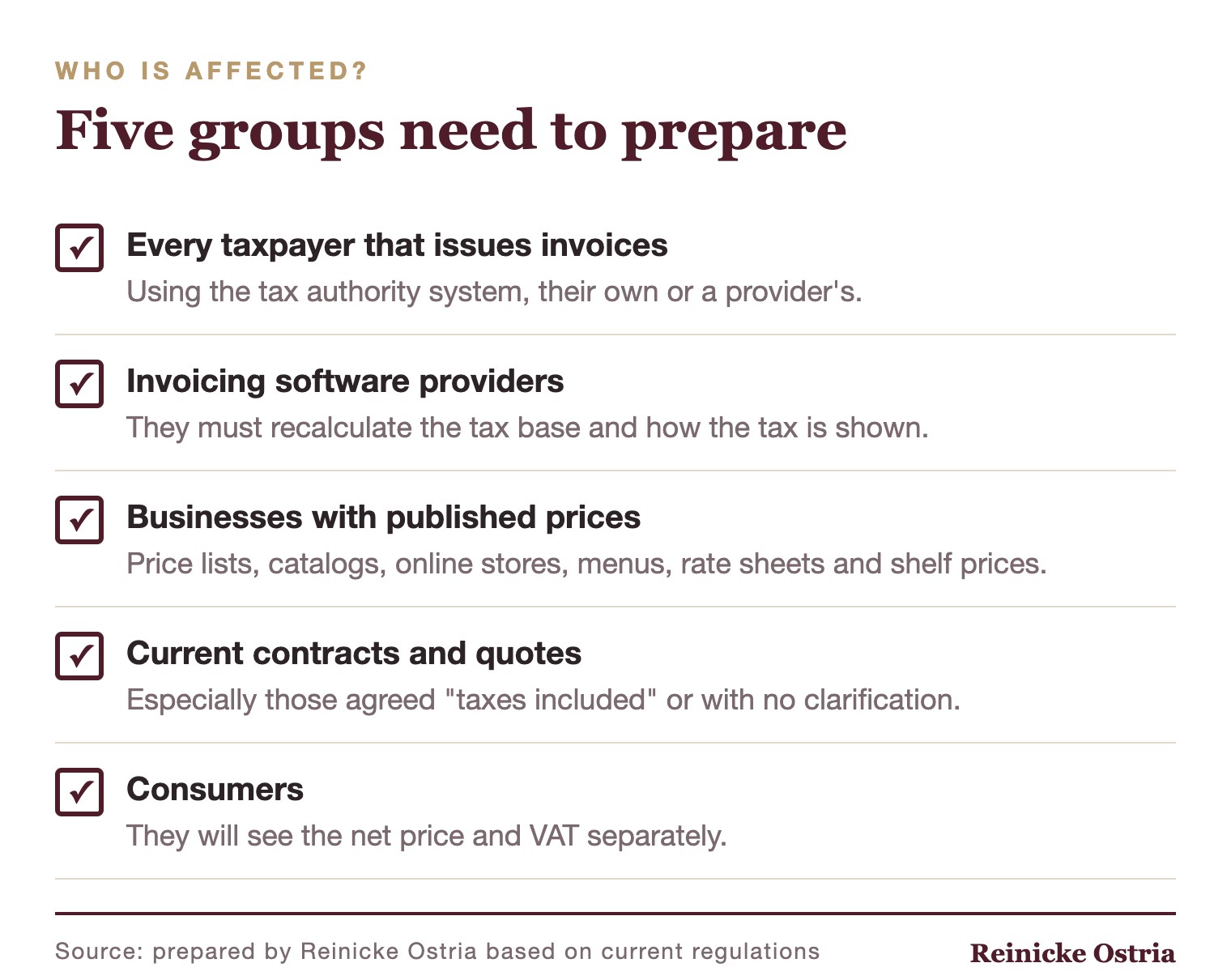
6. Who is affected?
7. Risks for companies
• Systems not adapted: on the effective date, a system that still calculates VAT as included would issue incorrect invoices.
• Ambiguous contracts: in a long-term contract that does not state whether the price includes VAT, the change may lead to disputes over how much the customer must pay.
• Outdated prices: price lists, online stores and advertising could show amounts that do not match the invoice.
• Margins: a last-minute pricing decision may reduce margins or competitiveness.
8. What remains to be defined?
The regulatory decree must specify the operational details, including:
• How the tax will be shown on the invoice.
• How ongoing transactions will be treated, as well as contracts signed before the change.
• How invoicing systems and records will be adjusted.
• The effects on tax credit and other related regimes.
Until it is published, the current invoicing rules, RND No. 102100000011, remain in force.
9. Checklist: get ready now

10. Frequently asked questions
Do I already have to invoice with VAT on top?
No. The change only takes effect on the first day of the month after the regulatory decree is published, and it has not been issued yet.
Does the VAT rate change?
Law No. 1733 changed the tax base (art. 5 of Law No. 843). The nominal rate remains 13%.
Will my products become more expensive?
It depends on each company's strategy. If the net price is kept, the final price drops slightly. If the final price is kept, the seller's net income rises.
What happens to contracts I have already signed?
You need to review what each contract says and what the decree provides. If the contract is unclear, it is best to clarify it before the change.
At Reinicke Ostria we support companies in contract review, tax compliance and strategy in the face of regulatory changes. For a consultation, please contact us through our contact page.
This document is for informational purposes only and does not constitute legal advice. Each case must be evaluated individually.
Reinicke Ostria — Vision beyond. Precision always.