
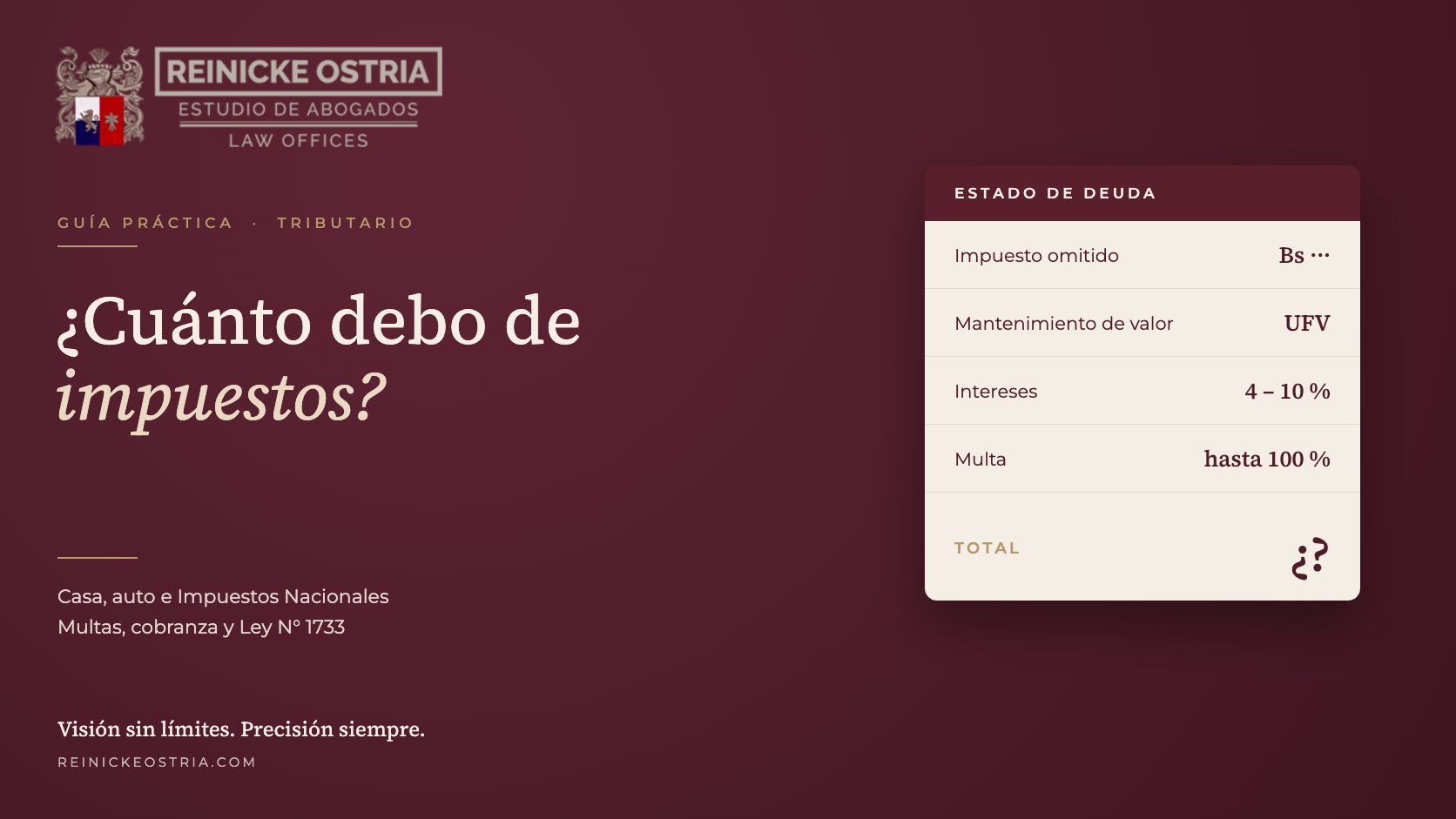
PRACTICAL GUIDE | TAX
Cochabamba, October 2026
"How much do I owe in taxes?" is one of the most searched questions in Bolivia. The answer depends on the tax. Taxes on your home and your car are collected by the municipality. VAT (IVA), the transaction tax (IT), corporate income tax (IUE) and RC-IVA are collected by the National Tax Service (SIN). Here we explain how to check each debt, what happens if you don't pay, and which benefits are available until 31 December 2026.
1. Taxes on your home or car (municipality)
Real estate property tax and vehicle property tax are municipal taxes. In most municipalities they are checked and paid on the RUAT website:
• Go to www.ruat.gob.bo and choose your municipality.
• Select Inmuebles (property) or Vehículos (vehicles) and then Consulta Deuda (debt inquiry).
• Enter the data requested, for example the property number or the licence plate.
• You can pay online by QR or at authorized financial institutions.
If your municipality is not on RUAT, ask at the municipality directly. RUAT does not issue certificates: the no-debt certificate is issued by the municipality and is required, for example, to sell or transfer a property or a vehicle.
2. Debts with the National Tax Service (SIN)
There are three ways to find out whether you owe the SIN:
• SIAT online (impuestos.gob.bo): with your username and password you can see pending returns, returns filed but not paid, and payment plans.
• Buzón Tributario (tax mailbox): this is where SIN notices arrive, such as charge notices (vistas de cargo), resolutions and fine notices. Deadlines run even if you do not open the notice, so check it often.
• SIN offices: if you have no access to the platform, you can ask in person.
Some fines, for example for amending returns or cancelling invoices, may not appear in the system. If in doubt, request a statement at the office.
3. What happens if you don't pay?
The debt grows. The unpaid tax is indexed in UFV and bears interest that rises over time: 4% a year up to the fourth year, 6% from the fifth to the seventh, and 10% from the eighth (art. 47 of the Tax Code, Law 2492).
There is a penalty for non-payment. Not paying or underpaying is penalized with 100% of the tax debt (art. 165). The penalty disappears if you pay by the tenth day after the charge notice (art. 157) and is reduced by 80%, 60% or 40% depending on the stage at which you pay afterwards (art. 156).
There are fines for formal obligations. For example, not issuing an invoice, filing late or not updating your details. They arrive as an "auto inicial de sumario contravencional", known as a fine notice.
Enforced collection may follow. A return filed and not paid already allows the SIN to collect directly, without a lawsuit. At that stage it can freeze bank accounts, seize and auction assets, and prohibit their sale or transfer.
4. What changed in 2026: Law 1733 on tax relief
Law No. 1733 of 27 May 2026 brings three benefits for debts with the SIN and the National Customs:
Debt forgiveness. On a one-time basis, debts and fines for periods before January 2018 and for the whole of 2020 are forgiven. Forgiveness of periods before 2018 does not apply to taxpayers whose accumulated unpaid tax was Bs 10,000,000 or more as of 31 December 2017. Fines for formal obligations not linked to an audit, committed up to 31 December 2025, are also forgiven.
Regularization of periods 2018 to 2025. You pay only the unpaid tax, without interest or penalties: in cash, with a 50% discount on indexation, or in up to 36 monthly instalments. The deadline was extended to 31 December 2026 by Supreme Decree No. 5708. If you stop paying the instalments, you lose the benefits.
Four-year statute of limitations. The law rewrote articles 59 and 60 of the Tax Code. The SIN now has 4 years to audit, assess debts, impose penalties and collect; 2 years to collect penalties already imposed; and 2 more years if the taxpayer did not register or registered under the wrong regime. The period runs from 1 January of the year after the payment due date.
Article 150 of the Tax Code allows rules that set shorter limitation periods to apply retroactively. How this applies to older periods is debated, so the limitation defence should be raised in writing and properly argued, not taken for granted.
Important: the forgiveness and regularization under Law 1733 apply only to debts with the SIN and Customs. They do not cover municipal taxes on your home or car. If you have old municipal debts, you can ask the municipality to declare the relevant years time-barred.
5. Frequently asked questions
How do I find out how much I owe on my home or car?
At www.ruat.gob.bo, by choosing your municipality and the Consulta Deuda option. If your municipality is not on RUAT, ask at the municipality.
How do I know if I owe the National Tax Service?
On SIAT online with your username and password, by checking your Buzón Tributario, or at a SIN office.
What happens if I don't pay taxes?
The debt grows with interest, a penalty of up to 100% of the tax is added, and the SIN can enforce collection: freeze funds, seize assets and prohibit their sale.
I received a fine notice. What should I do?
Check the date of the offence. If it is a fine for formal obligations not linked to an audit and the offence occurred on or before 31 December 2025, it may be forgiven under Law 1733. If not, you have a deadline to file your defence: do not let it expire.
Until when can I apply for Law 1733?
Regularization of periods 2018 to 2025 closes on 31 December 2026 (Supreme Decree No. 5708).
Are my taxes time-barred?
The general period is now 4 years from 1 January of the year after the due date, but it is interrupted or suspended in certain cases, for example when an assessment is notified, when you acknowledge the debt or when you request a payment plan. Each case must be reviewed.
Need help?
At Reinicke Ostria we review your position with the SIN and the municipality, assess whether to regularize, raise the limitation defence or challenge the assessment, and support you throughout the process. Contact us on WhatsApp or through our contact page. We serve clients in Cochabamba and Santa Cruz, nationwide.
This article is for information only and does not replace advice on a specific case.