

LEGAL ALERT | BANKING AND FINANCE
Cochabamba, November 2026
Since the flexible exchange-rate regime took effect, borrowers, savers and companies have been asking how dollar obligations entered into before 26 June 2026 are to be settled. In recent days, the Ministry of Economy and Public Finance, the Financial System Supervisory Authority (ASFI) and the Central Bank of Bolivia (BCB) issued three statements worth knowing.
I. Ministerial Resolution No. 416 and ASFI's clarification
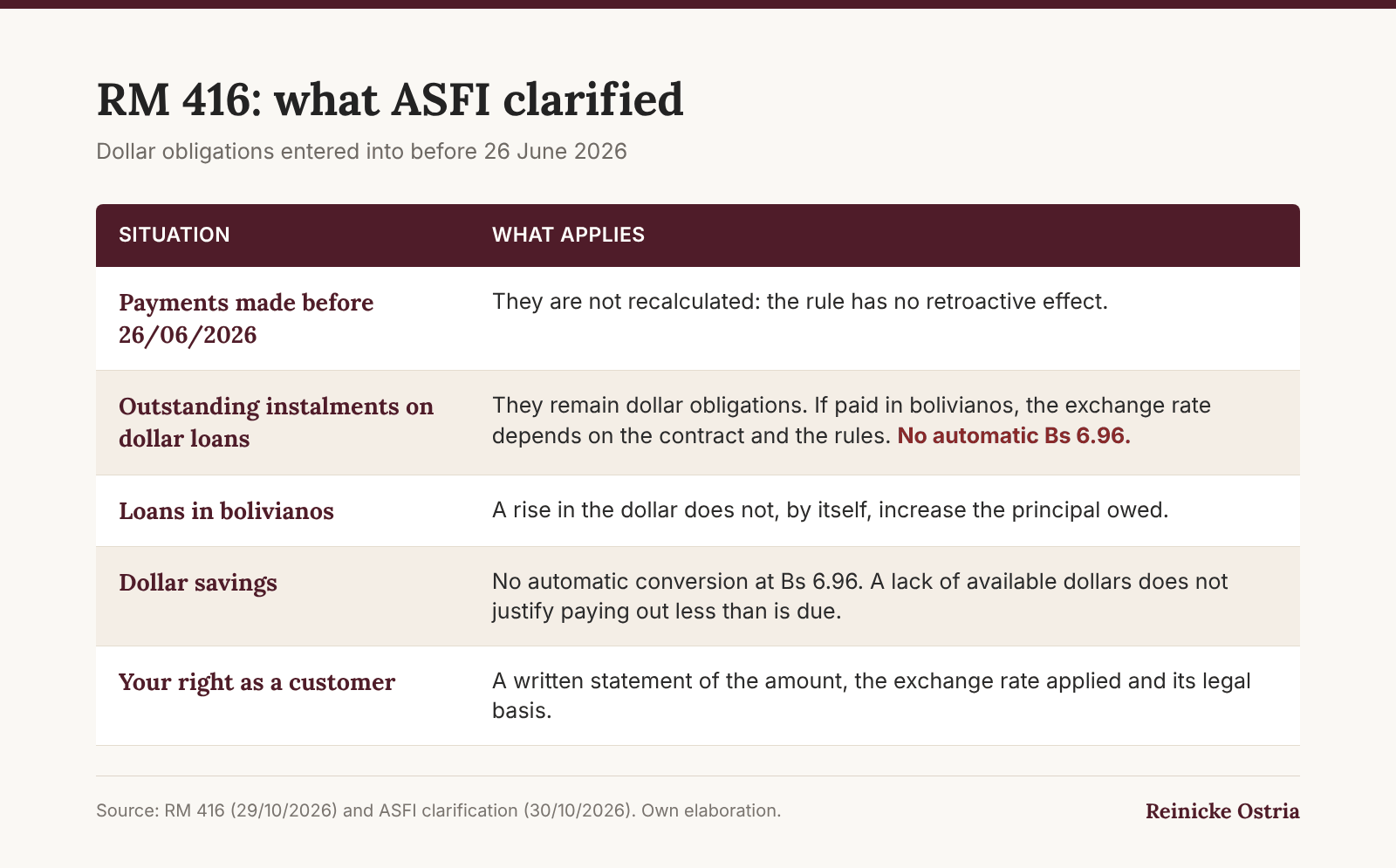
Ministerial Resolution No. 416 of 29 October 2026 specifies that the flexible exchange-rate rule applies from 26 June 2026, with no retroactive effect. It therefore does not allow payments already made before that date to be recalculated.
Given the different readings that circulated, ASFI clarified on 30 October that this resolution does not set an exchange rate of Bs 6.96 for all outstanding instalments on dollar loans taken out before 26 June. In practice:
1. Dollar loans. The instalment remains a dollar obligation. If it is paid in bolivianos, the applicable exchange rate depends on the contract and the rules in force.
2. Loans in bolivianos. A rise in the dollar does not, by itself, increase the principal owed.
3. Dollar savings. Having deposited before 26 June does not give an automatic right to receive the amount converted at Bs 6.96. If it must be returned in bolivianos, the institution must explain how it calculates the amount. A lack of available dollars does not justify paying out less than is due.
4. Transparency. The institution must explain in writing how much is to be paid or received, which exchange rate applies and why.
II. The BCB brings forward the return of dollars
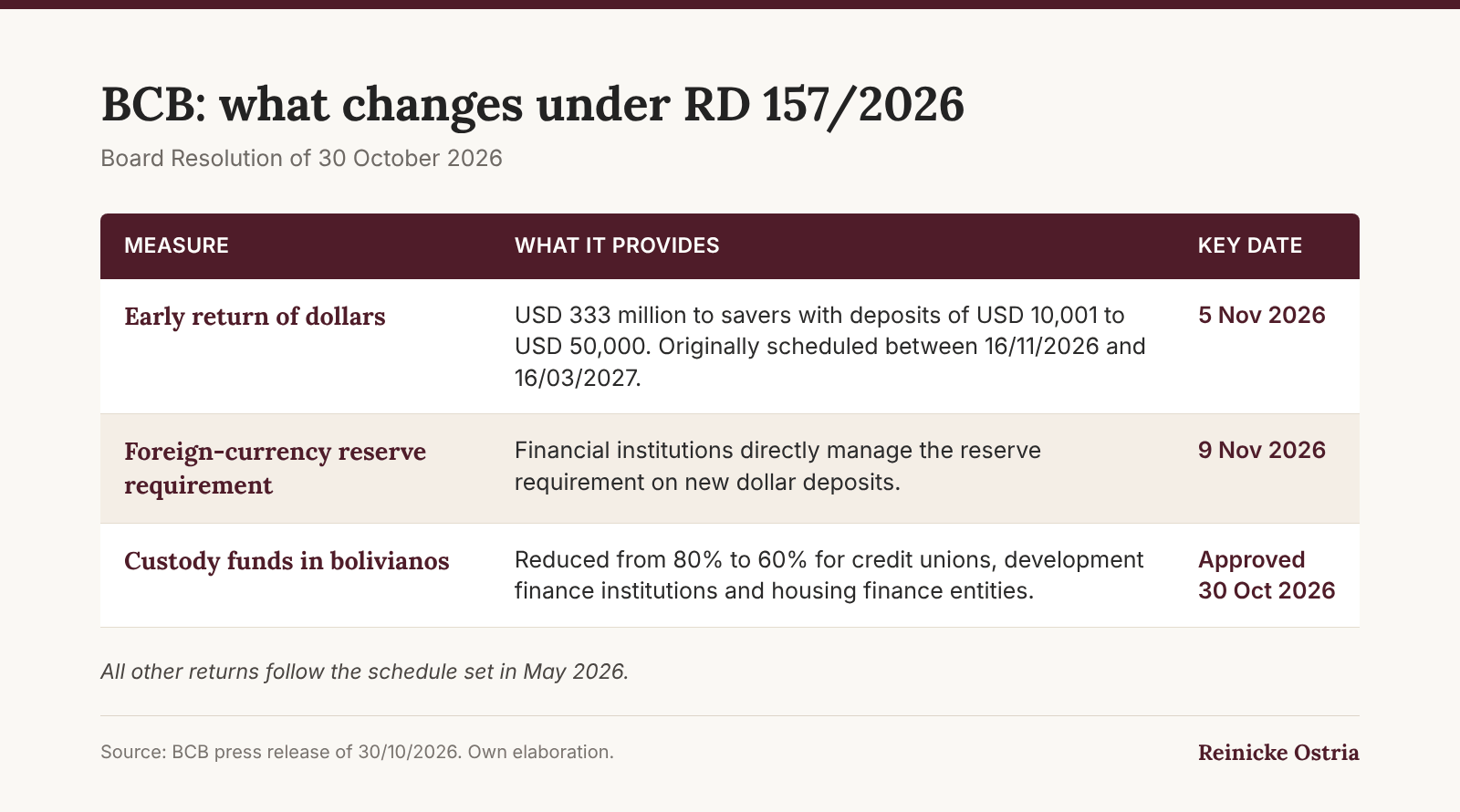
Through Board Resolution No. 157/2026 of 30 October 2026, the BCB brought forward to Thursday 5 November the return of USD 333 million to savers with deposits of between USD 10,001 and USD 50,000. Those payments had been scheduled between 16 November 2026 and 16 March 2027. All other returns follow the schedule set in May 2026.
The same resolution provides that, from 9 November 2026, financial institutions will directly manage the reserve requirement on new foreign-currency deposits. It also reduces from 80% to 60% the local-currency custody funds of credit unions, development finance institutions and housing finance entities.
III. Recommendations
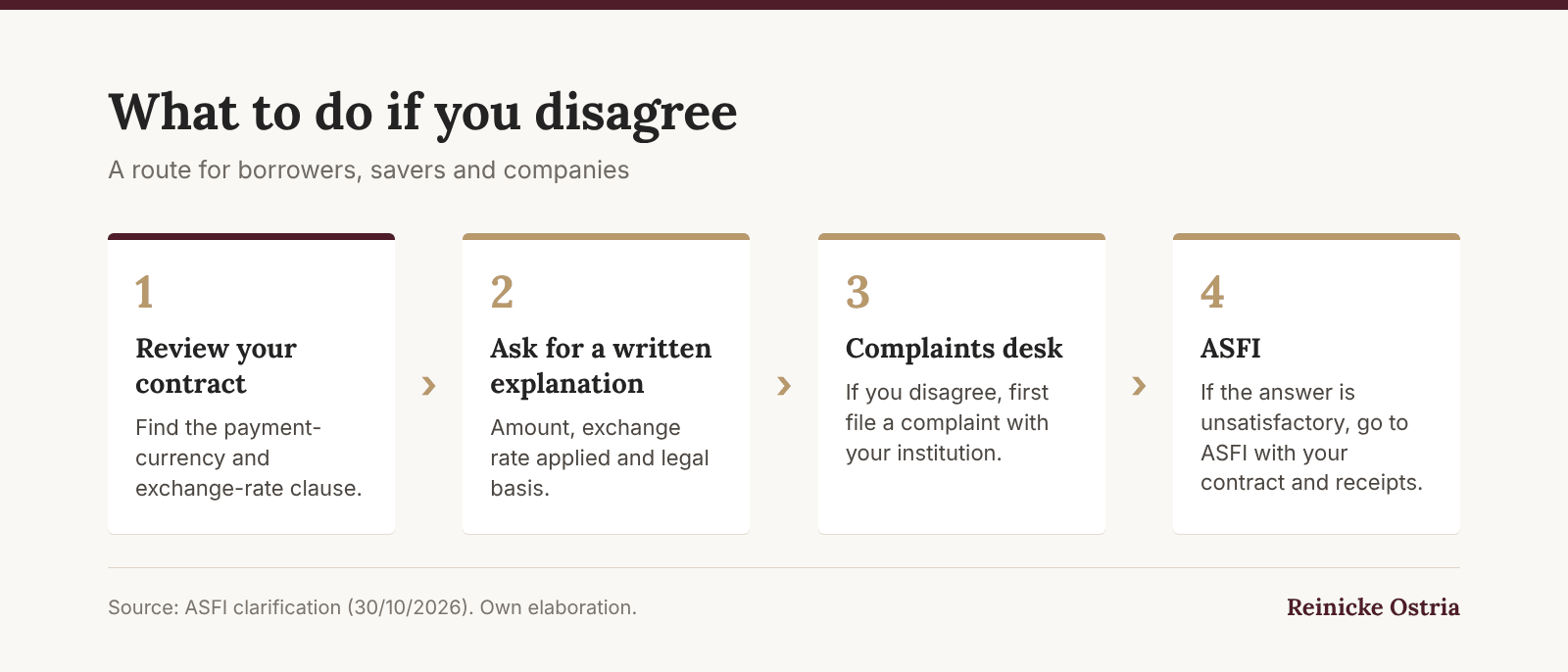
• Review your contract. Find the payment-currency and exchange-rate clause of your loan or deposit; it determines how much you must pay or receive.
• Ask for a written explanation. Request from your institution the breakdown of the amount, the exchange rate applied and its legal basis.
• Complain in the right order. If you disagree, file a complaint with the institution's complaints desk (Punto de Reclamo). If the answer is unsatisfactory, go to ASFI with your contract and receipts.
• Companies. Also review dollar-denominated contracts with customers, suppliers and landlords, and your foreign-currency invoicing and collection policy.
• 2027 budget. Project your dollar obligations under different exchange-rate scenarios.
Reference legislation
• Ministerial Resolution No. 416 of the Ministry of Economy and Public Finance, of 29 October 2026.
• BCB Board Resolution No. 157/2026, of 30 October 2026.
• ASFI statement of 30 October 2026.
This document is for information purposes only and does not constitute legal advice. Each case must be assessed on its own merits.
Reinicke Ostria — Vision beyond. Precision always.