

LEGAL ALERT | REGULATORY AND ENERGY
Cochabamba, October 2026
After the new diesel pricing regime, the Government has extended the same indexation logic to the electricity sector. Supreme Decree No. 5750 of 13 October 2026 amends the Prices and Tariffs Regulation (approved by Supreme Decree No. 26094) and the Electricity Market Operation Regulation, and changes how maximum electricity prices and tariffs are updated.
I. What the decree provides
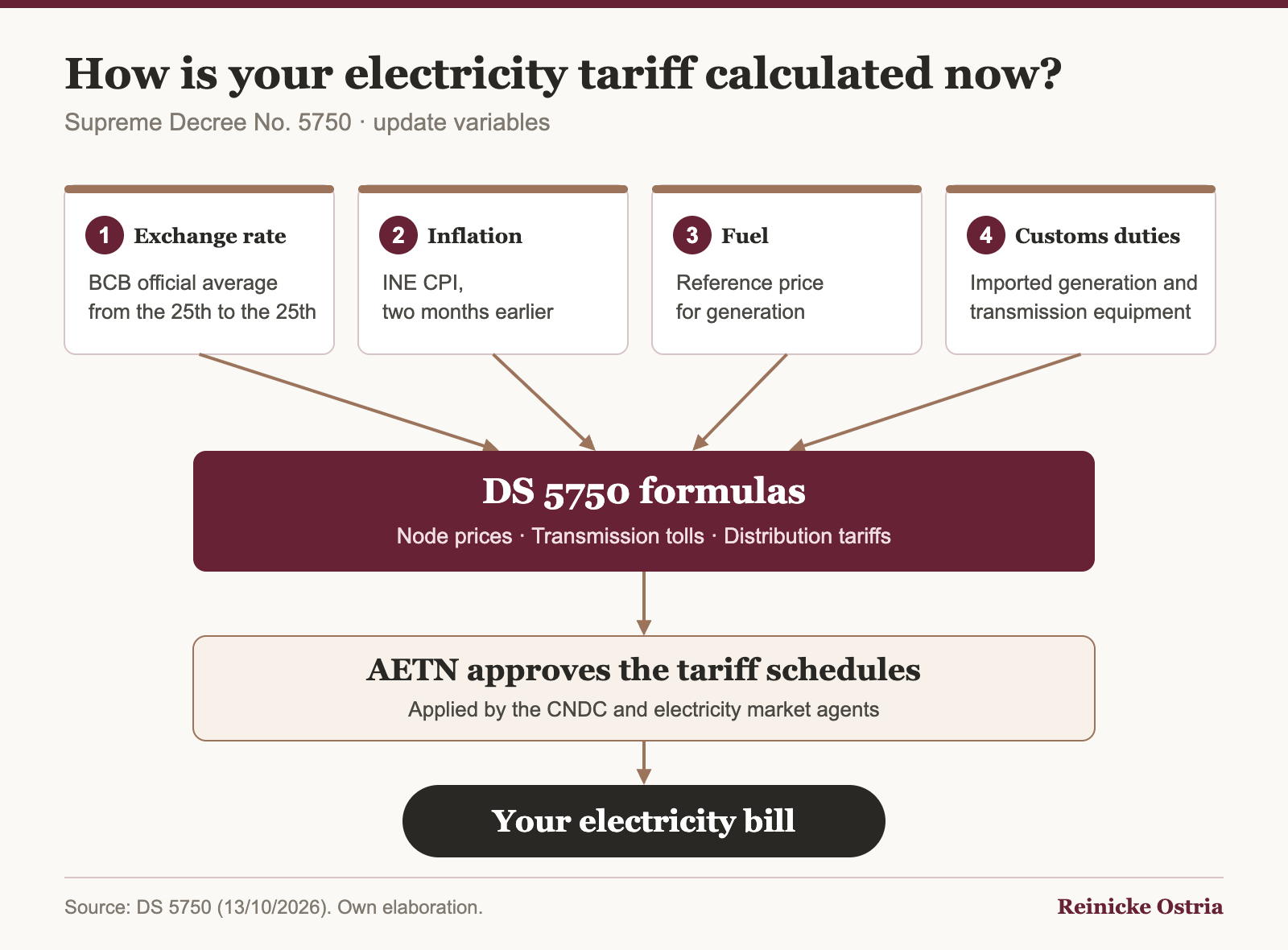
The decree sets the formulas used to periodically update node prices, transmission tolls, the investment, operation, maintenance and administration costs of the National Interconnected Trunk System, and base distribution tariffs. The formulas rely on four variables:
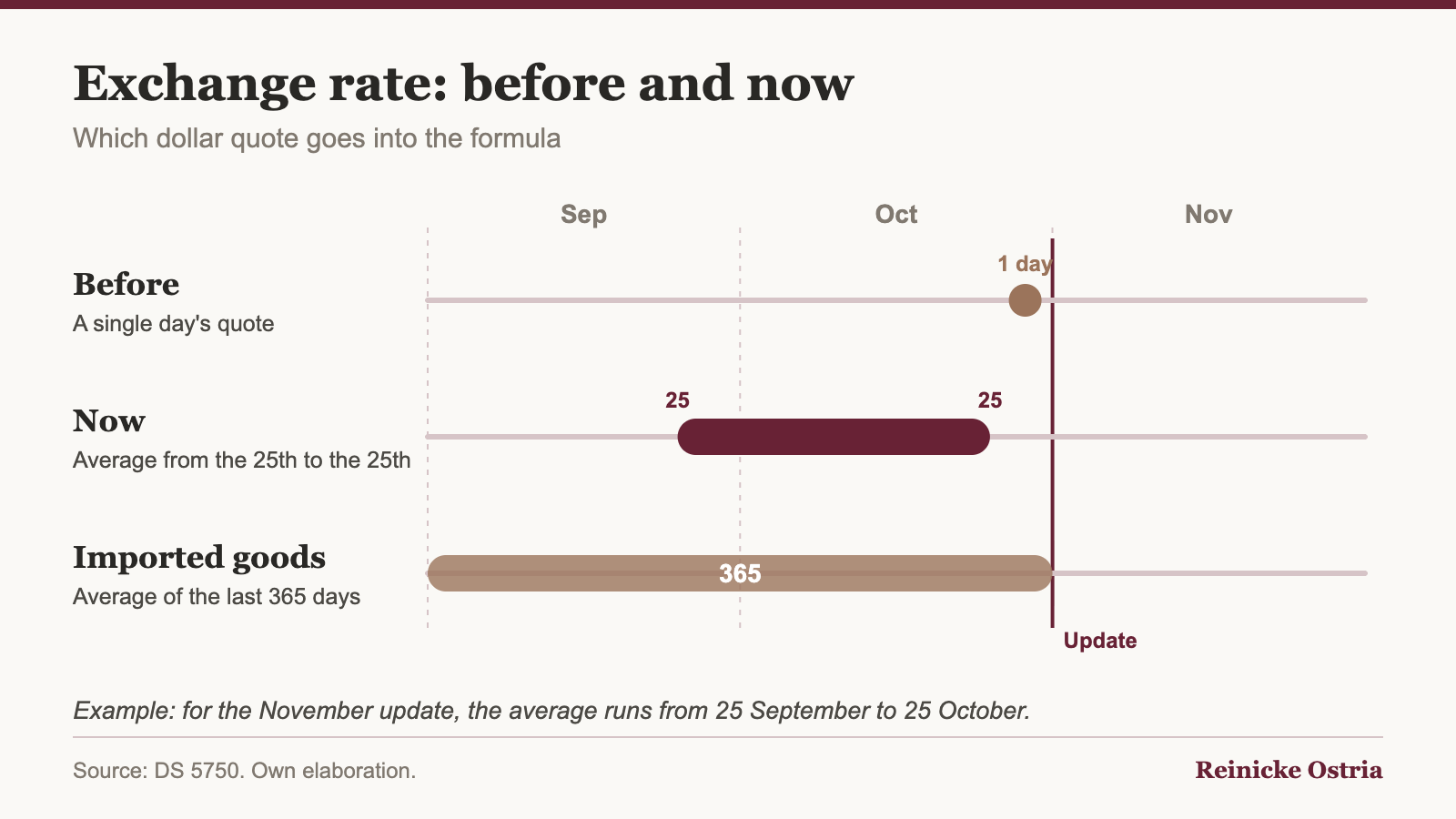
1. Exchange rate. The average of the official exchange rate quotes of the Central Bank of Bolivia (BCB) recorded between the 25th day of two months before and the 25th day of the month before the update. Previously, a single day's quote was used. For imported goods, the average of the previous 365 calendar days is used.
2. Inflation. The Consumer Price Index (CPI) published by the National Statistics Institute (INE) for the second month before the update.
3. Fuel. The reference price of the fuel used by generating units, for the energy price.
4. Customs duties. Those applied to imported electromechanical equipment for generation and transmission.
The new formulas apply from the publication of the decree. They are applied by the Electricity and Nuclear Technology Oversight Authority (AETN), the National Load Dispatch Committee (CNDC) and electricity market agents. The Ministry of Hydrocarbons and Energy is responsible for its implementation.
II. Will electricity bills go up?
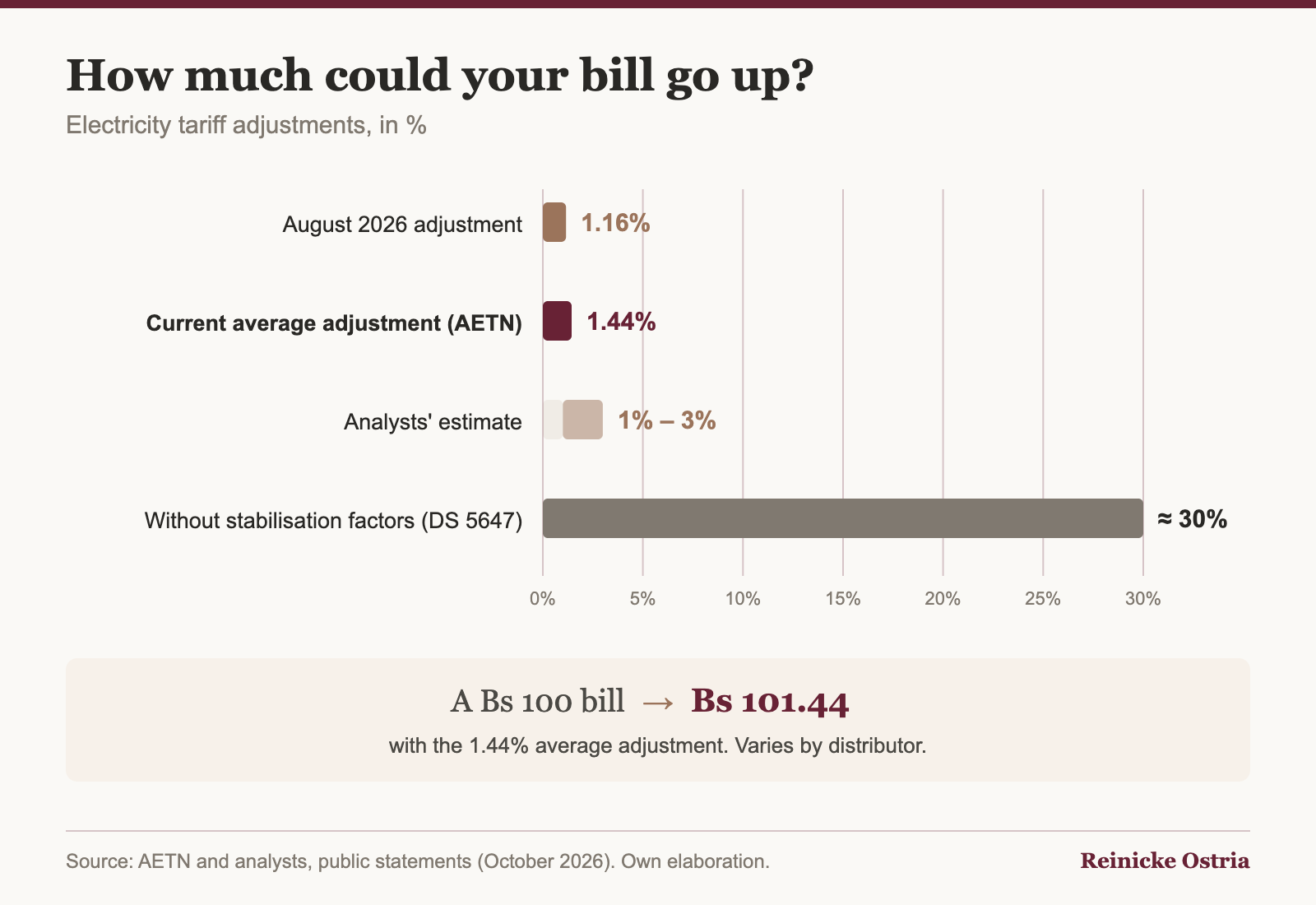
The Government states that the decree does not raise tariffs and that the monthly exchange rate average is meant to avoid sudden changes. It also stated that the Tarifa Dignidad (social tariff) remains in place.
The available figures point to moderate, but not zero, adjustments. The AETN reported an average national tariff adjustment of around 1.44%, which varies by distribution company in each department. Some analysts estimate adjustments of between 1% and 3%.
What is clear is that, with an official exchange rate that is no longer fixed (Bs 11.69 per US dollar on 19 October 2026, according to the BCB), the cost of energy will depend increasingly on the dollar, inflation and fuel prices. For industry, retail and energy-intensive businesses, electricity is no longer a stable cost but a variable to be managed.
III. Recommendations
• Review your long-term contracts: sales, leases with energy included, services and supply. Check whether they include price adjustment clauses for costs or the exchange rate, and how they are calculated.
• In new contracts: agree adjustment formulas based on objective, verifiable indices, such as the BCB official exchange rate and the INE CPI, with clear frequency and caps.
• If you contract with the State: check what your contract allows regarding price adjustments and what procedure it requires.
• Follow AETN resolutions: they set the specific tariff schedules that will apply to your bill.
• 2027 budget: project energy costs under different exchange rate and inflation scenarios.
Legal references
• Supreme Decree No. 5750 of 13 October 2026.
• Prices and Tariffs Regulation, approved by Supreme Decree No. 26094.
• Electricity Market Operation Regulation.
This document is for information only and does not constitute legal advice. Each case must be assessed individually.
Reinicke Ostria — Vision beyond. Precision always.